Podcasts
Practical, compassionate guidance from GBMC clinicians for every stage of life.
GBMC’s Simulation Innovation Learning Center has expanded greatly since it was opened as a Simulation Lab in 2012, following generous donations from the LaVerna Hahn Charitable Trust, The Middendorf Foundation, and The Women's Hospital Foundation.
Located in South Chapman, the Center began with four main components:
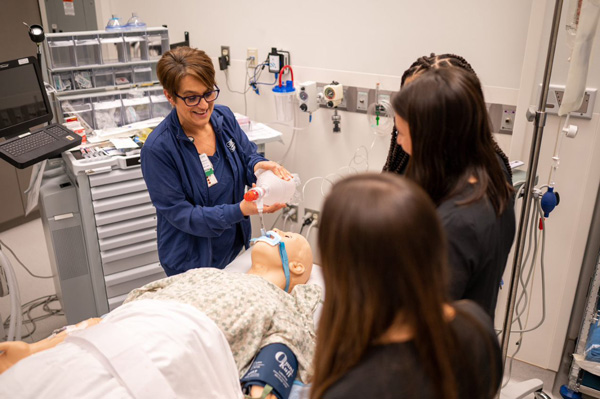
In 2018, thanks to additional funding from The Women’s Hospital Foundation, Inc., GBMC Volunteer Auxiliary, and Rosenthal-Statter Foundation, Inc., the lab underwent a significant expansion to become the Simulation Innovation Learning Center as we know it today. Now, in addition to a skills lab and debrief rooms, the Center features multiple other replica rooms created to imitate real-life GBMC HealthCare settings, including the Emergency Department, post-anesthesia care unit, a standard inpatient room, critical care room, mother/baby suite, outpatient physician office, consultation space, and an operating room. The rooms are designed to look exactly like the rooms within the health system that they depict, down to the finest detail, including type of doors and medical equipment available to bathrooms and ceiling lifts.
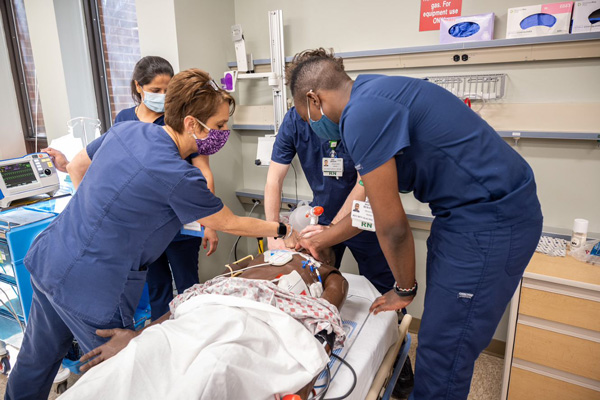
The simulations and actions of the high-fidelity manikins are steered in a large control room by Deborah Higgins, DNP, RN, CHSE, Simulation Manager & AHA Training Center Coordinator, and her team. “I call the control room ‘Oz’ because that’s where the magic happens,” Deb explains.
"As you can imagine, because the Center is inclusive of so many different types of settings, more teams from a variety of specialties are now able to train here,” she says, adding that the newest group is anesthesiology. Interns and residents utilize the space as part of their education, which includes rapid response code training and ICU bootcamp. Cadaver labs are even offered. And, at times, trained volunteers are brought in to act as patients to provide workplace violence training or to offer practice caring for patients exhibiting behavioral or cognitive challenges.
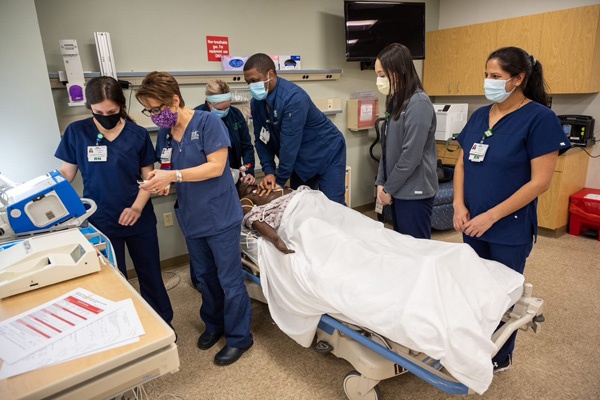
In medical training, there is a common saying: “See one, do one, teach one.” The Simulation Innovation Learning Center gives staff the opportunity to practice (i.e., “do one”) in a safe – yet realistic – setting before having to react to unexpected or challenging situations in real life for the first time. “It is extremely rewarding to run into people who have trained in the Center and hear that the simulation they participated in helped prepare them for something they experienced in their work area afterward,” says Deb. “Knowing that the work we do is helping our teams help patients in rapid time and feel more confident at the bedside shows that our simulations are making an important impact in the quality of our care and outcomes for our patients.”

Ranked as one of the hospitals in Maryland with the highest stroke survival and recovery ratesAccording t...
Review GBMC’s Quality & Patient Safety Metrics — our transparency dashboard showing performance on CLABSI, hand hygiene, HCAHPS, hospice comfort, and more.”
img.wellbeing { max-width:900px; } @media only screen and (max-width : 700px) { img.wellbeing { ma...
GBMC is committed to the wellness of each employee as a whole person – this includes physical, emotiona...
...
Practical, compassionate guidance from GBMC clinicians for every stage of life.